
I agree Our site saves small pieces of text information (cookies) on your device in order to deliver better content and for statistical purposes. You can disable the usage of cookies by changing the settings of your browser. By browsing our website without changing the browser settings you grant us permission to store that information on your device.
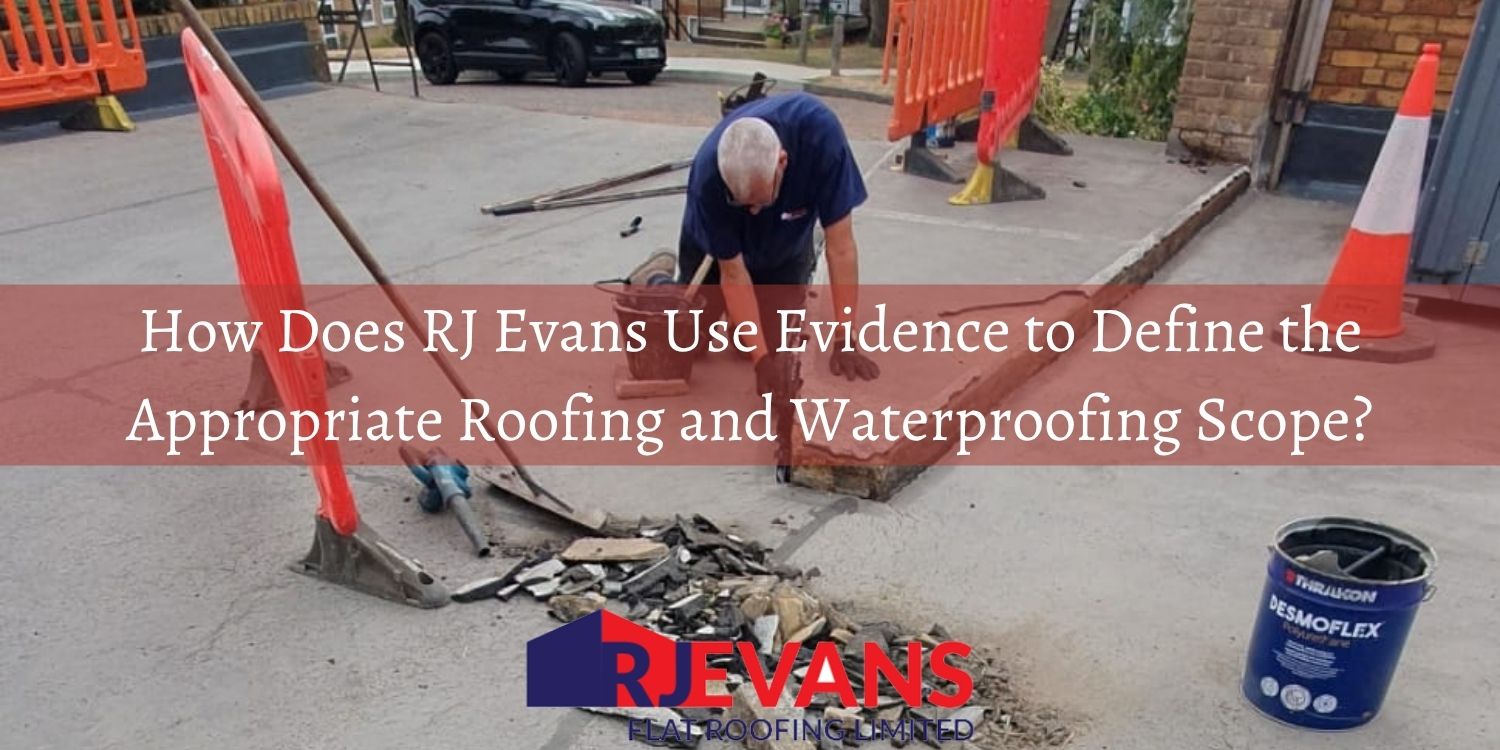
RJ Evans uses technical evidence to define the appropriate roofing and waterproofing scope rather than basing intervention on the most visible defect or on assumption alone. The objective is to establish what has failed, why it has failed, how far deterioration extends, which components remain suitable for continued service, and what level of work is required to restore dependable performance. An evidence-based remedial scope can range from localised repair and corrective detailing through refurbishment, overlay, partial replacement, or complete replacement. The correct intervention depends on the actual condition of the roofing or waterproofing system and the evidence available, not on a predetermined preference for either minimal repair or wholesale replacement.
Technical evidence → determines → the appropriate roofing or waterproofing remedial scope.
Evidence can be obtained through formal roof and condition surveys, leak investigation, moisture assessment, core sampling, electronic leak detection, thermal imaging, targeted opening-up, drainage assessment, review of existing construction, previous repair history, and the observed behaviour of the roofing or waterproofing system. These findings are then interpreted to distinguish the visible symptom from the underlying failure mechanism. A leak may result from a local waterproofing defect, but it may also involve concealed moisture, failed interfaces, drainage problems, movement, unstable substrates, deteriorated insulation, adjoining construction, or several interacting conditions.
Observed symptom → must be interpreted alongside → failure mechanism, moisture pathway, deterioration extent, and concealed construction condition.
Defining the correct scope also requires establishing the extent of the problem. A defect affecting one detail may remain suitable for targeted repair, while deterioration extending across a wider but defined area may require refurbishment or partial replacement. Where failure affects substantial parts of the system or the retained construction can no longer provide a reliable basis for further work, complete replacement may be appropriate.
Deterioration extent → influences → the scale of the required remedial intervention.
RJ Evans also determines which parts of the existing construction can remain in service. Waterproofing, insulation, roof decks, substrates, drainage components, interfaces, and other retained materials can continue to form part of the completed system where technical evidence supports their future performance. Wet, unstable, deteriorated, incompatible, or otherwise unreliable construction may require repair, removal, or replacement.
Retained component condition + compatibility + expected future performance → determine → whether existing construction is retained, repaired, or replaced.
The remedial scope must also account for the conditions that influence future performance. Drainage, falls, substrates, insulation, vapour control, interfaces, material compatibility, fire-performance requirements, building use, access, and the intended function of the completed system can all affect whether the proposed intervention is technically appropriate. Evidence-based scope selection therefore connects investigation with action. Survey findings and diagnostic evidence are used to define which defects require correction, which materials can remain, which areas require removal, how new work should integrate with retained construction, and whether the final strategy should involve repair, refurbishment, overlay, partial replacement, or complete replacement.
Investigation evidence → informs → diagnosis, retained-condition decisions, intervention threshold, and final remedial scope.
The primary objective is to define the smallest technically appropriate scope capable of correcting the identified failure and providing dependable future performance. This means retaining sound construction where evidence supports continued use while avoiding under-scoping where unresolved moisture, instability, incompatibility, drainage problems, or wider deterioration would compromise the completed work.
Evidence-based remedial scope selection → seeks to balance → defect correction, retained asset value, technical reliability, and future service performance.
RJ Evans therefore uses evidence as the basis for deciding what work should be carried out, what construction can remain, and where broader intervention is justified. The result is a roofing or waterproofing strategy grounded in the actual condition of the system rather than surface appearance, assumption, or repeated treatment of symptoms.
RJ Evans defines roofing and waterproofing scopes by combining evidence about the visible condition of the system, concealed construction, moisture distribution, water-ingress behaviour, drainage, substrates, interfaces, previous repairs, and the condition of materials intended to remain in service. The purpose is to establish sufficient evidence to determine what has failed, how far deterioration extends, what can be retained, and what work is technically required. The depth of investigation depends on the complexity of the problem and the decisions that must be made. A clearly identified local defect may require relatively limited investigation, while recurring leakage, concealed moisture, uncertain roof build-ups, multiple overlays, widespread deterioration, or complex interfaces can require additional testing, sampling, or opening-up before a reliable scope can be defined.
Required investigation depth → depends on → defect complexity, construction uncertainty, concealed condition, and the decisions the evidence must support.
Formal roof and condition surveys provide the initial evidence about the roofing or waterproofing system. RJ Evans considers the apparent construction, material condition, visible defects, drainage, falls, penetrations, interfaces, terminations, previous repairs, and signs of moisture or deterioration. The survey helps establish whether the observed problem appears localised or widespread and whether sufficient information exists to define the scope or whether further technical investigation is required.
Roof condition survey → establishes → visible condition, defect distribution, construction context, and further investigation requirements.
Leak investigation provides evidence about where water is entering, how it may be moving through the roof or adjoining construction, and which components are being affected. The location where water becomes visible internally does not necessarily identify the original external entry point. RJ Evans considers internal symptoms together with waterproofing condition, drainage, penetrations, interfaces, weather behaviour, adjoining building elements, and previous repairs so that the remedial scope addresses the actual water-entry mechanism rather than only the visible consequence.
Leak investigation → identifies → water-entry route, moisture pathway, affected construction, and probable failure cause.
Moisture can extend beyond the visible defect and affect insulation, substrates, decks, adhesion, thermal performance, or other concealed parts of the roof build-up. Establishing the distribution of moisture is therefore important when deciding how much existing construction can remain. RJ Evans can use or arrange appropriate moisture assessment where surface inspection cannot establish concealed condition reliably. The findings are interpreted alongside the roof build-up, leak history, material type, and other investigation evidence.
Moisture extent → influences → how much existing construction can be retained, repaired, or replaced.
Core sampling can provide direct evidence where the existing roof build-up is uncertain or where the condition of concealed layers must be understood before a remedial strategy is selected. A core can help establish the number and type of existing layers, insulation condition, moisture, retained waterproofing, substrates, and differences between assumed and actual construction. These findings can materially affect whether repair, overlay, refurbishment, sectional reconstruction, or replacement is technically appropriate.
Core sampling → provides → direct evidence of concealed roof build-up and material condition.
Targeted opening-up is appropriate where important decisions depend on construction that cannot be assessed adequately from the surface. It can expose substrates, decks, insulation, previous waterproofing layers, interfaces, or other concealed components at selected locations. This can confirm whether apparent surface deterioration is associated with deeper failure or whether substantial areas of underlying construction remain dry, stable, and suitable for continued service.
Targeted opening-up → verifies → concealed construction condition where scope decisions depend on direct physical evidence.
Electronic leak detection can be used or arranged where appropriate to identify potential discontinuities within compatible waterproofing systems. This can help determine whether an apparent leak relates to one isolated defect or whether additional discontinuities require corrective work. The results are considered alongside construction information, internal symptoms, drainage, interfaces, previous repairs, and other evidence before the extent of the remedial scope is determined.
Electronic leak detection → can provide evidence of → waterproofing discontinuities requiring targeted corrective work.
Thermal imaging can be used or arranged where temperature differences across a roof may indicate areas requiring closer investigation. These anomalies can correspond with differences in moisture condition, insulation, roof construction, or surface behaviour. Because thermal patterns are influenced by materials, weather, solar exposure, and survey timing, they are treated as supporting evidence rather than automatic proof of concealed failure. Where necessary, anomalies can be verified through moisture assessment, core sampling, or targeted opening-up.
Thermal anomalies → identify → areas requiring further verification before the final scope is confirmed.
Drainage evidence includes the condition and arrangement of falls, outlets, gutters, channels, overflows, low points, and surrounding levels. These factors determine how water moves across and leaves the roof and whether ponding or prolonged exposure is contributing to deterioration. If drainage forms part of the failure mechanism, a scope limited to repairing or renewing waterproofing may leave the underlying problem unresolved. Corrective work may therefore need to include drainage changes as part of the remedial strategy.
Drainage evidence → determines whether → water-management defects must form part of the remedial scope.
The condition of the substrate or roof deck can determine whether retained construction provides a suitable base for repair, refurbishment, overlay, or a new waterproofing system. Moisture, corrosion, decay, cracking, instability, damaged screeds, contamination, or loss of cohesion can prevent reliable installation over the existing construction. RJ Evans therefore considers whether the supporting construction can remain, requires local correction, or must be removed or replaced before the proposed roofing or waterproofing work proceeds.
Supporting-construction condition → determines → whether retained substrates or decks can support the proposed remedial system.
Waterproofing frequently changes, terminates, or connects with other construction around penetrations, parapets, kerbs, rooflights, outlets, thresholds, plant bases, walls, and adjoining materials. Evidence of deterioration at these locations can show that the failure is concentrated at a critical detail rather than across the principal roof area. Where several details or interfaces exhibit similar defects, the evidence may instead indicate a wider detailing, movement, compatibility, or system problem requiring broader intervention.
Interface condition → helps determine → whether the scope requires local detail correction or wider roofing intervention.
Previous repairs, coatings, overlays, sealants, and replacement details form part of the evidence when assessing an existing roofing system. Their condition and performance can show whether earlier interventions have remained effective or whether recurring defects indicate an unresolved underlying cause. Previous work can also conceal original construction, retain moisture, introduce incompatible materials, create additional interfaces, or alter levels and drainage. These conditions can affect whether further local repair or another overlay remains technically appropriate.
Previous intervention history → provides evidence about → recurring failure, material compatibility, concealed construction, and remaining refurbishment options.
Evidence-based scope selection considers serviceable construction as carefully as failed construction. Determining which areas remain dry, stable, compatible, adequately supported, and capable of reliable future performance is essential when deciding what can be retained. This prevents the scope from being defined only by the failed area and provides a technical basis for preserving existing roofing, insulation, substrates, decks, drainage components, and other construction where continued service is justified.
Evidence of serviceable construction → supports → proportionate retention within the final remedial scope.
Different investigation methods may not always provide a complete answer on their own. A visible defect may not explain the internal leak, a thermal anomaly may require physical verification, or a core sample may reveal construction that differs from what was assumed elsewhere on the roof. Where uncertainty remains material to the proposed scope, RJ Evans can use additional investigation to test the competing explanations rather than defining the works from incomplete evidence.
Material uncertainty → requires → further evidence before irreversible scope decisions are made.
RJ Evans does not treat surveys, moisture findings, testing, core samples, opening-up, drainage observations, previous repairs, internal symptoms, or apparently serviceable areas as isolated pieces of information. The findings are considered together to determine whether they support a consistent explanation of the failure and the wider condition of the roofing or waterproofing system. The strongest remedial scope is based on converging evidence: the observed symptoms should be consistent with the identified failure mechanism, concealed condition, moisture distribution, roof construction, and expected behaviour of the system.
Multiple evidence sources → are combined to establish → failure cause, deterioration extent, retained condition, and appropriate remedial scope.
The purpose is not investigation for its own sake. Evidence is gathered to answer the technical questions that determine what work should be carried out: what has failed, why it has failed, how far the problem extends, what can remain, what must be corrected or removed, and what intervention is required to provide dependable future performance.
Technical evidence → exists to support → proportionate, defensible, and technically appropriate scope selection.
RJ Evans therefore uses the level and type of investigation required to resolve the decisions that materially affect the remedial strategy. The resulting evidence provides the basis for defining a scope that corrects the identified failure, retains serviceable construction where justified, and avoids both under-scoping unresolved deterioration and unnecessarily replacing sound roofing or waterproofing assets.
RJ Evans interprets roofing and waterproofing evidence by connecting visible symptoms, concealed construction, moisture distribution, drainage, material condition, interfaces, previous repairs, and observed system behaviour into a technically coherent explanation of the failure. The objective is not simply to collect survey information, but to determine what the evidence means for the condition of the roof and the scope of work required. Individual findings can be misleading when considered in isolation. A visible crack may be the result of substrate movement, an internal leak may originate some distance from where water appears, a thermal anomaly may require physical verification, and a local waterproofing defect may have allowed moisture to spread through a much larger area of insulation or supporting construction.
Technical evidence → must be interpreted to establish → failure mechanism, deterioration extent, retained condition, and remedial requirement.
The visible symptom is not always the condition that must ultimately be corrected. Water staining, cracking, splitting, blistering, ponding, surface deterioration, or repeated patch failure can each result from another problem within the roofing or waterproofing system. RJ Evans considers the observed defect alongside the roof build-up, moisture evidence, movement, drainage, substrates, interfaces, previous repairs, and adjoining construction to determine whether the visible condition represents the cause of failure or only its consequence.
Visible symptom → must be distinguished from → the failure mechanism and underlying cause.
A failure mechanism explains how and why the roofing or waterproofing system has lost performance. Possible mechanisms can include loss of waterproofing continuity, movement, substrate instability, inadequate drainage, failed interfaces, material incompatibility, moisture entrapment, deterioration of supporting construction, or defects within adjoining building elements. RJ Evans compares the available evidence against the expected behaviour of the system to determine which explanation is consistent with the observed symptoms, construction, moisture pattern, and failure history.
Failure mechanism → explains → how the identified condition produces the observed roofing or waterproofing problem.
The apparent size of a visible defect does not necessarily represent the extent of deterioration. A small entry point can allow water to spread through insulation or between layers, while several visible defects may remain confined to individual details rather than indicate failure of the complete roof. RJ Evans considers defect distribution, moisture evidence, testing, opening-up, previous repairs, material condition, and the condition of surrounding areas to determine whether failure remains localised, affects a defined section, or extends across a wider part of the system.
Failure extent → determines whether → the problem is localised, sectional, or system-wide.
Moisture distribution helps show how far water has travelled beyond the apparent point of failure and which concealed components may have been affected. The significance of moisture depends on its location within the roof build-up, the materials involved, the suspected entry route, and whether affected construction remains suitable for continued service. RJ Evans interprets moisture evidence alongside core samples, opening-up, leak history, drainage, internal symptoms, and the known roof construction rather than treating one moisture reading as sufficient evidence on its own.
Moisture distribution → helps establish → affected construction, deterioration extent, and retention viability.
Core sampling and opening-up can reveal conditions that materially change the interpretation of the roof. Wet insulation, multiple previous overlays, deteriorated substrates, unexpected deck construction, retained membranes, or hidden repairs can explain why the visible condition differs from the performance of the wider system. RJ Evans uses this evidence to verify assumptions about the build-up and determine whether concealed materials support or contradict the proposed remedial strategy.
Concealed construction evidence → verifies → whether the assumed roof build-up and condition are technically accurate.
Ponding or restricted drainage may be the direct cause of deterioration in some situations and a contributing condition in others. Water can remain on the surface because of poor falls, blocked outlets, altered levels, settlement, damaged drainage components, or changes introduced during previous works. RJ Evans considers whether drainage conditions correspond with the location and pattern of failure and whether correcting the waterproofing without addressing water movement would leave the original risk active.
Drainage evidence → helps determine → whether water management is a cause, contributor, or separate maintenance issue.
Failures at penetrations, upstands, outlets, parapets, kerbs, rooflights, thresholds, plant bases, terminations, and material transitions must be interpreted in relation to the adjoining construction. The defect may result from poor continuity, inadequate support, movement, incompatible materials, geometry, drainage, or deterioration of the neighbouring element. RJ Evans determines whether the problem can be corrected locally or whether similar conditions occur across multiple details and indicate a wider design, material, or system issue.
Interface failure pattern → helps determine → whether local detail correction or wider intervention is required.
Repeated repairs provide evidence about how the roof has behaved over time. A repair that fails repeatedly in the same location can indicate that the underlying mechanism remains active, while successive patches across adjacent areas can show that deterioration is progressing beyond the original defect. RJ Evans considers the location, type, age, compatibility, and performance of previous work when determining whether further local repair remains technically justified.
Recurring repair failure → can indicate → an unresolved cause or deterioration extending beyond the previous repair scope.
Evidence interpretation must identify not only what has failed but also what remains capable of reliable continued service. Waterproofing, insulation, decks, substrates, drainage components, interfaces, and other parts of the existing construction can be retained where they remain sufficiently dry, stable, compatible, and suitable for the future system. RJ Evans considers the condition, moisture, support, compatibility, service history, and expected future performance of these components before deciding whether retention is technically appropriate.
Serviceable retained construction → must demonstrate → adequate condition, stability, compatibility, and future performance.
Roofing failures can involve several plausible explanations at the same time. A roof may contain defective drainage, ageing waterproofing, previous repairs, movement, and vulnerable interfaces, while only one or some of these conditions are responsible for the reported problem. Where the available evidence does not clearly separate competing explanations, RJ Evans can use additional investigation to test the possibilities rather than defining the remedial scope around an unverified assumption.
Multiple plausible causes → require → further evidence until the material uncertainty affecting the scope is resolved.
The significance of a defect depends on more than its visible size. A relatively small failure can be technically important if it allows water into insulation, affects a structural deck, compromises a critical interface, threatens occupied areas, or exposes a much larger area of serviceable construction to deterioration. RJ Evans therefore considers the defect together with its likely consequence, moisture pathway, affected components, potential for progression, and effect on the future performance of the system.
Defect significance → depends on → cause, consequence, deterioration extent, and the construction exposed to further failure.
Once the evidence establishes the failure mechanism, deterioration extent, condition of concealed materials, and serviceability of surrounding construction, RJ Evans can determine the intervention threshold. A localised failure with sound surrounding construction may support targeted repair. Wider correctable deterioration may justify refurbishment or overlay. Defined sectional failure may require partial replacement, while widespread moisture, unsuitable substrates, repeated system failure, or unreliable retained construction can justify complete replacement.
Interpreted evidence → converts → observed condition into a technically justified intervention threshold.
RJ Evans therefore interprets roofing and waterproofing evidence to establish a coherent relationship between the observed problem, its underlying cause, the extent of affected construction, and the condition of materials proposed for retention. This interpretation is what allows the final remedial scope to be proportionate to the actual failure rather than based on the most obvious symptom or an assumed solution.
RJ Evans uses interpreted survey and investigation evidence to determine the level of roofing or waterproofing intervention that is technically justified. The decision is based on the identified failure mechanism, extent of deterioration, moisture distribution, condition of concealed construction, serviceability of retained materials, drainage, interfaces, compatibility, and the future performance required from the completed system. The purpose is not to select the largest or smallest possible scope. It is to define the smallest technically appropriate intervention that corrects the identified failure without retaining construction that would undermine future performance.
Failure cause + deterioration extent + retained serviceability → determine → the appropriate remedial intervention.
Localised repair may be appropriate where the evidence shows that the defect is confined to a defined area, the underlying cause can be corrected, concealed deterioration has not spread materially beyond the defect, and the surrounding roofing or waterproofing construction remains serviceable. The repair scope should address both the visible defect and the condition responsible for it. A local patch is not evidence-based where movement, moisture, substrate deterioration, drainage, or failed interfaces remain unresolved.
Defined failure + correctable cause + serviceable surrounding construction → can support → localised repair.
A final remedial scope should not be fixed where material uncertainty remains about the cause of failure, concealed moisture, roof build-up, substrate condition, extent of deterioration, or suitability of construction intended for retention. Where these uncertainties could change whether the correct intervention is repair, refurbishment, overlay, or replacement, further moisture assessment, core sampling, opening-up, testing, or other targeted investigation may be required first.
Material uncertainty affecting the intervention decision → requires → further evidence before the final scope is defined.
Refurbishment may be appropriate where the evidence shows that substantial parts of the existing construction remain suitable for continued service but the system requires wider corrective work than a local repair can provide. The scope may include removal of isolated wet construction, substrate repairs, renewed waterproofing, corrected drainage, replacement of failed details, interface reconstruction, insulation work, or other measures necessary to restore dependable performance while retaining technically sound components.
Serviceable retained construction + wider correctable deterioration → can support → refurbishment.
An overlay may be appropriate where investigation confirms that the retained construction is sufficiently dry, stable, compatible, and suitable to form part of the completed system. The evidence must support continued retention rather than simply show that the existing roof can physically be covered. RJ Evans considers moisture, substrate condition, adhesion, movement, drainage, levels, interfaces, detailing, material compatibility, thermal requirements, fire-performance requirements, and the condition of existing layers before defining an overlay scope.
Verified suitable retained construction → can support → a technically appropriate roofing or waterproofing overlay.
An overlay may be unsuitable where evidence identifies widespread moisture, unstable substrates, incompatible retained materials, unresolved movement, defective drainage, extensive deterioration, or uncertainty about concealed construction that materially affects future performance. Retaining such conditions beneath a new system can conceal rather than resolve the existing failure and transfer technical risk into the completed roof.
Evidence of unsuitable retained construction → prevents → reliable overlay as the remedial strategy.
Partial replacement may be appropriate where investigation identifies significant deterioration within a clearly defined section while adjoining construction remains serviceable and capable of continued performance. The evidence must support both sides of the decision: the failed section must justify removal, and the retained section must demonstrate sufficient condition, stability, compatibility, and future serviceability. A reliable technical boundary must also be capable of being formed between new and retained work.
Defined sectional failure + verified serviceable adjacent construction → can support → partial replacement.
Complete replacement may be appropriate where evidence shows widespread waterproofing failure, extensive concealed moisture, unsuitable decks or substrates, deterioration across multiple system components, recurring failure after previous interventions, or retained construction that cannot provide a dependable basis for further refurbishment. At this point, continued repair or retention may no longer represent a technically reliable strategy because the failure is no longer confined to individual defects or sections.
Widespread failure + unreliable retained construction → can justify → complete roof or waterproofing replacement.
Scope selection requires positive evidence for retention as well as evidence of failure. RJ Evans considers whether waterproofing, insulation, vapour-control layers, decks, substrates, drainage components, interfaces, and other existing construction remain dry enough, stable enough, compatible enough, and sufficiently serviceable to form part of the completed system. Construction is not retained simply because it has not visibly failed, and it is not removed simply because another part of the roof has deteriorated.
Evidence of future serviceability → supports → retention of existing roofing and waterproofing components.
The remedial scope must include contributing conditions where the evidence shows that they form part of the failure mechanism. Renewing waterproofing without correcting defective falls, restricted outlets, vulnerable interfaces, failed terminations, or unsuitable adjoining construction can leave the original cause active. RJ Evans therefore incorporates drainage, detailing, interfaces, and supporting construction into the scope where investigation demonstrates that these conditions materially affect performance.
Contributing failure condition → must be included within → the remedial scope where correction is required for reliable future performance.
Under-scoping occurs where the proposed work treats the visible defect but fails to address concealed deterioration, moisture, unstable substrates, drainage problems, incompatible materials, failed interfaces, or other conditions that are likely to cause recurring failure. Evidence-based scope selection reduces this risk by extending the work to every component that must be corrected for the proposed system to perform reliably.
Incomplete correction of the failure mechanism → increases → the risk of recurring roofing or waterproofing failure.
Evidence also protects serviceable construction from unnecessary removal. Where surveys, moisture findings, opening-up, and material assessment demonstrate that significant parts of the roof remain suitable for continued service, the remedial strategy can be confined to the areas and components that actually require intervention. This allows sound roofing, insulation, decks, substrates, drainage components, and other existing materials to be retained where continued performance is technically justified.
Verified serviceable construction → supports → a proportionate scope without unnecessary replacement.
Once the intervention level has been established, RJ Evans converts the evidence and diagnosis into a defined remedial scope or specification. This identifies what is to remain, what requires removal or repair, how substrates should be prepared, which roofing or waterproofing system is appropriate, and how drainage, interfaces, penetrations, terminations, compatibility, thermal requirements, and other critical conditions are to be addressed. The specification should therefore be traceable back to the findings of the investigation rather than represent a generic system choice applied independently of the existing roof.
Interpreted evidence + intervention decision → inform → the final roofing or waterproofing specification.
The objective is to define a remedial strategy proportionate to the actual condition of the roofing or waterproofing system. The scope should be broad enough to correct the identified failure and provide dependable future performance, but no broader than the evidence technically justifies.
Evidence-based remedial scope → seeks to balance → complete defect correction, sound-construction retention, technical reliability, and proportionate intervention.
RJ Evans therefore moves from investigation to action by using evidence to establish the intervention threshold. Localised repair, refurbishment, overlay, partial replacement, and complete replacement are not predetermined solutions; they are outcomes of the evidence gathered about failure cause, deterioration extent, retained condition, and the performance required from the completed roofing or waterproofing system.
RJ Evans continues to test the remedial scope against the actual condition of the roofing or waterproofing construction as work progresses. Initial surveys, testing, sampling, and opening-up define the starting strategy, but additional evidence can emerge once coverings, insulation, interfaces, previous repairs, or supporting construction are exposed. The objective is to confirm that the assumptions supporting repair, refurbishment, overlay, partial replacement, or retention remain technically valid. Where newly exposed conditions materially change the understanding of the roof, the scope can be refined so that the completed work reflects the construction actually encountered rather than an assumption made before access was available.
Initial remedial scope + verified site condition → determine → whether the defined work should be confirmed, reduced, or expanded.
Some parts of an existing roof cannot be assessed fully until materials are removed or concealed construction is exposed. Opening the roof can confirm the original investigation or reveal conditions that were inaccessible beforehand. These can include additional wet insulation, deteriorated substrates, unexpected waterproofing layers, concealed repairs, damaged decks, unsuitable interfaces, or construction that differs from the recorded or assumed roof build-up.
Exposure of concealed construction → can provide → new evidence affecting the remedial scope.
Where the remedial strategy depends on retaining existing waterproofing, insulation, decks, substrates, drainage components, or other construction, the exposed condition must remain consistent with the basis on which retention was selected. RJ Evans considers whether those components remain sufficiently dry, stable, compatible, adequately supported, and capable of providing the required future performance. Where the evidence continues to support retention, serviceable construction can remain within the completed system.
Verified future serviceability → supports → retention of existing roofing and waterproofing construction.
If removal or opening-up reveals that deterioration extends beyond the originally identified boundary, the scope may need to expand. Additional wet insulation, unstable substrates, deck deterioration, concealed waterproofing failure, or unsuitable previous construction can reduce the amount of material that can reliably remain in service. The revised boundary should follow the evidence separating failed or affected construction from material that remains technically suitable for retention.
Greater-than-expected deterioration → can justify → proportionate expansion of the remedial scope.
Site evidence can also show that a greater proportion of the existing roof is suitable for continued service than anticipated. Where exposed construction remains dry, stable, compatible, and capable of reliable future performance, unnecessary removal can be avoided. The remedial scope should therefore be capable of reducing as well as expanding where the evidence supports a more limited intervention.
Better-than-expected retained condition → can justify → preservation of additional serviceable construction.
New waterproofing depends on the condition of the construction beneath it. The substrate must provide a suitable base in terms of stability, preparation, moisture condition, compatibility, support, and surface integrity. Where exposure reveals cracking, contamination, damaged screeds, unstable boards, corrosion, decay, loss of cohesion, or other defects, these conditions should be corrected before the new waterproofing system is installed.
Verified suitable substrate → provides → the technical basis for reliable waterproofing installation.
Removal of existing construction can provide clearer evidence of the relationship between falls, outlets, gutters, channels, low points, surrounding levels, and the waterproofing system. This may confirm the planned drainage strategy or demonstrate that further correction is required. Where drainage contributed to the original failure, the completed works should not reproduce the same condition within the refurbished or replacement roof.
Verified drainage condition → confirms or refines → the water-management requirements within the remedial scope.
Penetrations, thresholds, parapets, kerbs, rooflights, plant bases, outlets, terminations, and transitions between materials can contain concealed geometry, support arrangements, previous repairs, or movement conditions that become apparent only after surrounding construction is opened. RJ Evans uses the exposed condition to confirm how new waterproofing should integrate with retained materials and whether the original detailing strategy remains appropriate.
Exposed interface condition → informs → the final detail between new and retained construction.
Existing roofs can contain undocumented overlays, additional insulation, old waterproofing systems, local alterations, previous repairs, or different constructions across separate roof areas. Where the actual build-up differs materially from the assumed construction, RJ Evans reassesses whether the difference affects moisture behaviour, adhesion, compatibility, thermal performance, fire performance, drainage, detailing, or the suitability of retained materials.
Material difference between assumed and actual construction → requires → reassessment where it affects the technical strategy.
The scope should be revised where new evidence materially changes the failure diagnosis, extent of deterioration, condition of retained construction, compatibility of the proposed system, or the ability of the completed works to provide reliable future performance. The scope should neither remain fixed where evidence shows that additional correction is necessary nor expand simply because additional work is possible.
Material new evidence → justifies → proportionate revision of the remedial scope.
Where additional work becomes necessary, the technical reason should be traceable to a newly verified site condition. Wet insulation, unstable substrates, concealed deterioration, incompatible construction, defective drainage, or failed interfaces provide a clear technical basis for explaining why the originally defined scope requires adjustment. This creates a direct relationship between the condition encountered and the additional work proposed.
Verified site condition → provides → the technical basis for justified scope variation.
Evidence-based scope control operates in both directions. New deterioration can justify additional work, while verified sound construction can justify retaining areas that do not require intervention. RJ Evans therefore continues to distinguish between failed, affected, and serviceable construction as work progresses so that the final intervention remains proportionate to the actual condition encountered.
Evidence-based scope control → prevents → both unresolved under-scoping and unnecessary over-scoping.
The completed remedial strategy should maintain a clear relationship between the original problem, investigation findings, conditions exposed during delivery, and the corrective work ultimately carried out. Each significant element of the final scope should correspond to an identified technical requirement, such as repairing a waterproofing defect, replacing affected construction, correcting drainage, preparing an unsuitable substrate, rebuilding an interface, or replacing a system that can no longer provide reliable service.
Failure diagnosis + verified site condition → should correspond to → the corrective work ultimately delivered.
The objective is to keep the remedial scope technically appropriate from investigation through to completion. Initial evidence defines the strategy, while evidence revealed during delivery confirms whether the assumptions supporting that strategy remain valid.
Evidence-based scope verification → seeks to maintain → complete defect correction, justified retention, proportionate intervention, and dependable future performance.
RJ Evans therefore treats remedial scope definition as an evidence-led process throughout the project. Where site conditions confirm the original diagnosis, the planned work can proceed. Where material evidence differs, the scope can be refined so that the completed roofing or waterproofing system addresses the construction actually encountered while retaining sound materials wherever continued service remains technically justified.
An appropriate roofing or waterproofing scope should be based on the condition of the existing system, the identified failure mechanism, the extent of deterioration, and the serviceability of the construction proposed for retention. The objective is to determine what work is technically required rather than beginning with a predetermined preference for repair, refurbishment, overlay, or replacement. RJ Evans uses survey findings, leak investigation, moisture evidence, testing, core sampling, opening-up, drainage assessment, substrate condition, interfaces, previous repairs, and other relevant construction evidence to establish the technical basis for the remedial strategy.
RJ Evans → has the primary objective of → defining an evidence-based remedial scope.
The evidence is used to establish what has failed, why it has failed, how far the problem extends, which components can remain in service, and which conditions must be corrected to provide reliable future performance.
Technical evidence + failure diagnosis + retained-condition assessment → determine → the appropriate level of roofing or waterproofing intervention.
Where the evidence supports a localised response, the scope can remain proportionate to the defect. Where deterioration, moisture, substrate condition, drainage, interfaces, or wider system failure extend beyond a local repair, the intervention can progress to refurbishment, overlay, partial replacement, or complete replacement as technically justified. If material uncertainty remains, further investigation can be used to resolve the decisions that affect the scope. If concealed conditions exposed during the work differ from those originally identified, the scope can be refined so that the completed works remain aligned with the actual construction encountered. The objective is not simply to produce a schedule of works. It is to create a technically defensible relationship between the evidence, the diagnosis, and the corrective intervention while retaining sound construction wherever continued service is justified.
Evidence-based remedial scope selection → seeks to achieve → complete defect correction, proportionate intervention, justified retention, and dependable future performance.
If you need to establish the appropriate scope for a leaking, deteriorated, ageing, previously repaired, or technically complex roofing or waterproofing system, contact RJ Evans to assess the available evidence and define the remedial work required.