
I agree Our site saves small pieces of text information (cookies) on your device in order to deliver better content and for statistical purposes. You can disable the usage of cookies by changing the settings of your browser. By browsing our website without changing the browser settings you grant us permission to store that information on your device.
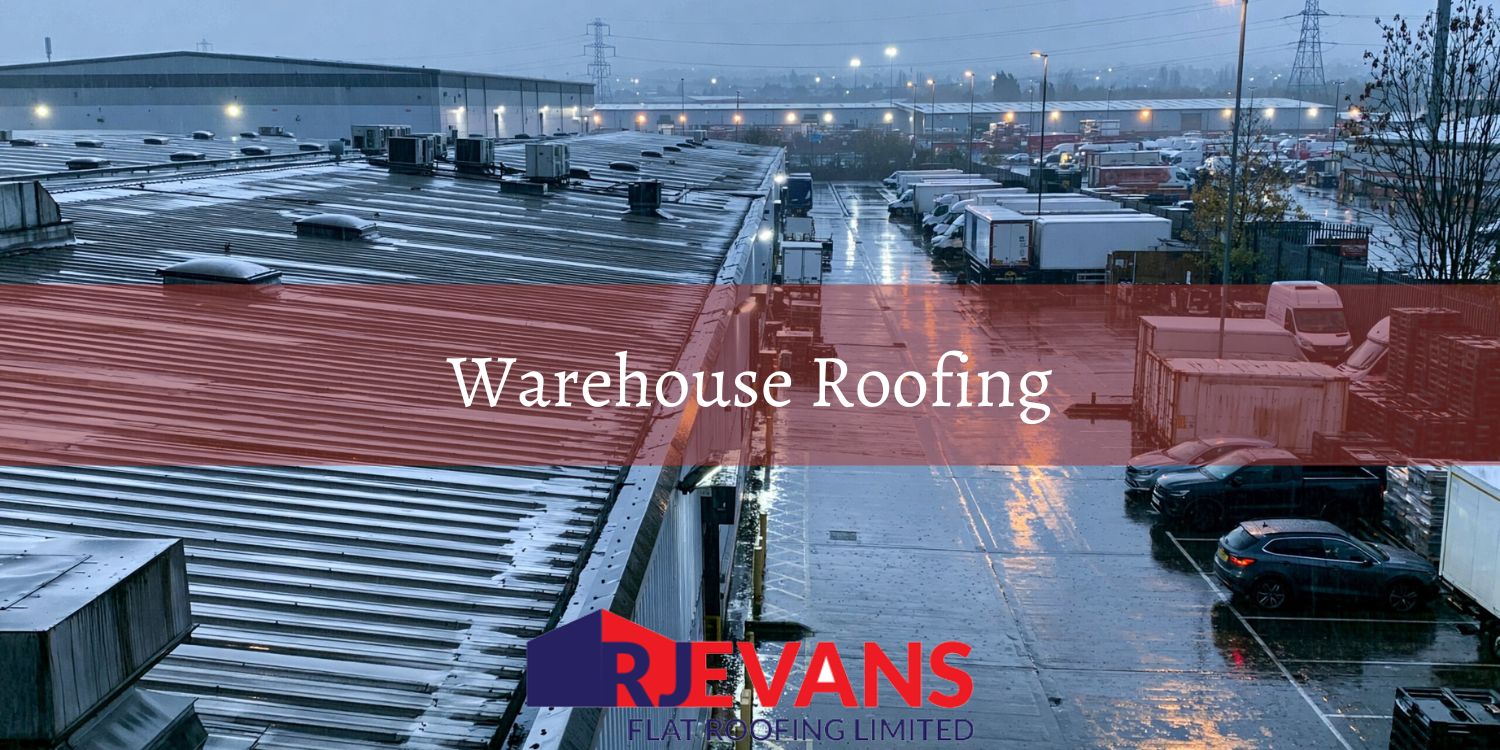
RJ Evans Flat Roofing Limited installs warehouse roofing systems to prevent water ingress, protect stored goods and equipment, and maintain the safe operation of warehouse and distribution facilities. Warehouse roofing is the design and installation of weatherproof roof systems for buildings with large roof areas, wide structural spans, and demanding operational requirements. The selected roofing system must suit the roof structure, drainage layout, insulation requirements, internal use, rooftop equipment, and environmental exposure of the warehouse. Warehouse roofing systems may use profiled metal sheets, single-ply membranes, built-up roofing, modified bitumen, liquid-applied waterproofing, or other materials compatible with the building and roof construction. The weatherproof covering is integrated with rooflights, vents, gutters, outlets, penetrations, plant supports, upstands, edges, joints, and adjoining details to maintain continuous protection across the complete roof area.
A warehouse roof must withstand prolonged weather exposure, temperature changes, maintenance traffic, and the operational demands of the facility. Effective drainage and correctly sealed roof details prevent moisture from reaching insulation, structural components, stock, machinery, loading areas, and internal working spaces. RJ Evans Flat Roofing Limited installs warehouse roofing systems to keep warehouses and distribution centres watertight, operational, energy-efficient where suitable insulation is specified, and protected throughout the service life of the roof.
The correct intervention for a warehouse roof depends on the extent of deterioration, the condition of the underlying roof assembly, and whether the existing system can continue to meet the operational requirements of the facility. An isolated defect may require localised repair, broader but recoverable deterioration may justify refurbishment or partial replacement, and system-wide failure may require complete reroofing.
RJ Evans Flat Roofing Limited assesses the roof covering, insulation, structural deck, fixings, drainage system, rooflights, penetrations, perimeter details, rooftop equipment, and internal signs of water ingress before recommending work. This establishes whether the roof can be repaired, retained within a refurbishment system, replaced across a defined section, or removed and renewed as a complete roofing assembly.
The appropriate warehouse roofing intervention may be:
Localised warehouse roof repair is appropriate where defects are confined to identifiable areas and the surrounding roof remains stable, dry, and serviceable. The repair must address the cause of failure rather than simply cover the point where water becomes visible inside the warehouse.
Localised warehouse roof repair may be appropriate in the following situations:
Isolated leak source → targeted repair may restore weatherproofing.
Leaks associated with a damaged fixing, open sheet lap, failed membrane seam, rooflight, penetration, gutter joint, outlet, or perimeter detail may be repaired where the adjoining materials remain sound. The source and route of the water ingress must be confirmed before work begins because water can travel beneath the roof covering before entering the building.
Localised material deterioration → the affected section can be repaired or selectively renewed.
Individual punctures, splits, corroded sheets, damaged fasteners, open joints, or isolated areas of coating failure do not necessarily require wider replacement. Local repair remains appropriate where the surrounding roof covering retains adequate attachment, flexibility, and weatherproofing performance.
Confined wet materials → targeted opening-up and reinstatement may be sufficient.
Where inspection confirms that moisture has not spread through the wider roof build-up, affected insulation, boards, membranes, or deck sections can be removed and replaced locally. The repaired area must be integrated with the retained roof to restore waterproofing, attachment, and thermal continuity.
Localised drainage failure → outlets, gutters, or isolated low points can be repaired.
Blocked outlets, leaking gutter joints, damaged downpipes, or isolated ponding areas may be corrected without replacing the wider warehouse roof. Where ponding results from widespread inadequate falls or an undersized drainage system, a broader refurbishment or replacement strategy may be required.
Warehouse roof refurbishment or partial replacement is appropriate where deterioration extends beyond an isolated repair but does not affect the complete roofing system. This approach retains serviceable roof areas while renewing or upgrading the sections that can no longer perform reliably.
Warehouse roof refurbishment or partial replacement may be appropriate in the following situations:
Viable roof assembly with surface deterioration → refurbishment may extend service life.
A warehouse roof may remain structurally stable while showing widespread surface wear, weathering, minor seam deterioration, or loss of protective coating performance. Subject to moisture, attachment, compatibility, and structural checks, the existing roof may support a suitable overlay, liquid-applied waterproofing system, replacement sheet layer, or another specified refurbishment system.
Sectional roof failure → partial replacement may be more reliable than repeated patching.
Partial replacement may be appropriate where failure is concentrated within one roof slope, structural bay, gutter line, rooflight band, extension, loading area, or moisture-damaged zone. Replacing the complete affected section can restore consistent performance without removing roof areas that remain serviceable.
Multiple connected detail failures → coordinated sectional refurbishment may restore continuity.
Where several rooflights, penetrations, joints, gutters, or perimeter interfaces are deteriorating within the same roof area, isolated sealing may produce inconsistent results. Refurbishing the complete zone allows the details to be redesigned and integrated into one continuous weatherproof system.
Serviceable roof covering with inadequate thermal performance → the roof build-up may be upgraded.
Refurbishment may allow suitable insulation, vapour control, rooflights, ventilation, or internal environmental requirements to be incorporated without complete removal of the existing roof. The retained assembly must be dry, stable, compatible with the proposed build-up, and capable of supporting any additional materials.
Localised operational or building change → the affected roof area can be redesigned independently.
Extensions, new rooftop plant, smoke vents, ventilation equipment, access hatches, solar equipment, or changes to loading and service areas may affect only part of the warehouse. Partial replacement can integrate these elements where the new and retained roof systems can be joined without creating weak drainage, movement, or waterproofing interfaces.
Complete warehouse roof replacement is required where deterioration, moisture, instability, or incompatible repairs affect the roof as a complete system. Replacement should be selected where retaining the existing roof would conceal continued failure, trap damaged materials, or continue an uneconomical cycle of recurring repairs.
Complete warehouse roof replacement may be required in the following situations:
System-wide deterioration → local repairs can no longer restore consistent performance.
Profiled metal sheets may show extensive corrosion, coating loss, open laps, or widespread fastener failure. Single-ply membranes may be brittle, detached, punctured, or repeatedly patched. Built-up and modified-bitumen roofs may contain widespread splitting, blistering, cracking, or surface breakdown. Where deterioration affects most of the roof, complete replacement restores one coordinated weatherproof covering.
Recurring leaks throughout the warehouse → the wider roofing assembly must be investigated and renewed.
Water ingress across several roof zones may indicate widespread covering failure, defective drainage, failed details, or concealed moisture movement. Where repairs repeatedly fail or new leaks continue to develop, further patching is unlikely to provide dependable long-term protection.
Widespread wet insulation or concealed materials → the damaged assembly must be removed.
Moisture beneath the visible roof covering can affect insulation, vapour-control layers, cover boards, fixings, structural decks, and internal finishes. Installing an overlay above widespread wet materials may trap deterioration and reduce thermal performance. Complete replacement allows saturated materials to be removed and the roof to be reconstructed as a dry, stable assembly.
System-wide instability → waterproofing repair alone cannot restore roof performance.
Widespread fastener failure, lifting sheets, membrane detachment, damaged decking, severe corrosion, or movement within supporting components can prevent the existing roof from retaining a repair or overlay system safely. Structural correction and coordinated roof replacement may therefore be required.
Multiple generations of incompatible repairs → the roof no longer performs as one continuous assembly.
Warehouse roofs containing overlapping patches, replacement sheets, coatings, membranes, and sealants may respond unevenly to temperature change, movement, moisture, and weather exposure. Where failure repeatedly develops around repair boundaries, complete replacement can remove incompatible materials and restore consistent system behaviour.
Major operational or performance changes → a new warehouse roofing design is required.
New insulation requirements, drainage layouts, rooflights, smoke-control systems, rooftop plant, solar equipment, access provisions, or internal environmental controls may require a substantially different roof build-up. Complete replacement allows these elements to be coordinated with the roof structure, waterproofing, drainage, and intended use of the warehouse.
RJ Evans Flat Roofing Limited selects the intervention according to the condition and distribution of roof defects. Localised repair is used where individual failures can be corrected reliably. Refurbishment or partial replacement is used where defined roof areas require broader renewal but serviceable sections can remain. Complete replacement is specified where deterioration, moisture, instability, or operational limitations affect the warehouse roof as a complete system.