I agree Our site saves small pieces of text information (cookies) on your device in order to deliver better content and for statistical purposes. You can disable the usage of cookies by changing the settings of your browser. By browsing our website without changing the browser settings you grant us permission to store that information on your device.
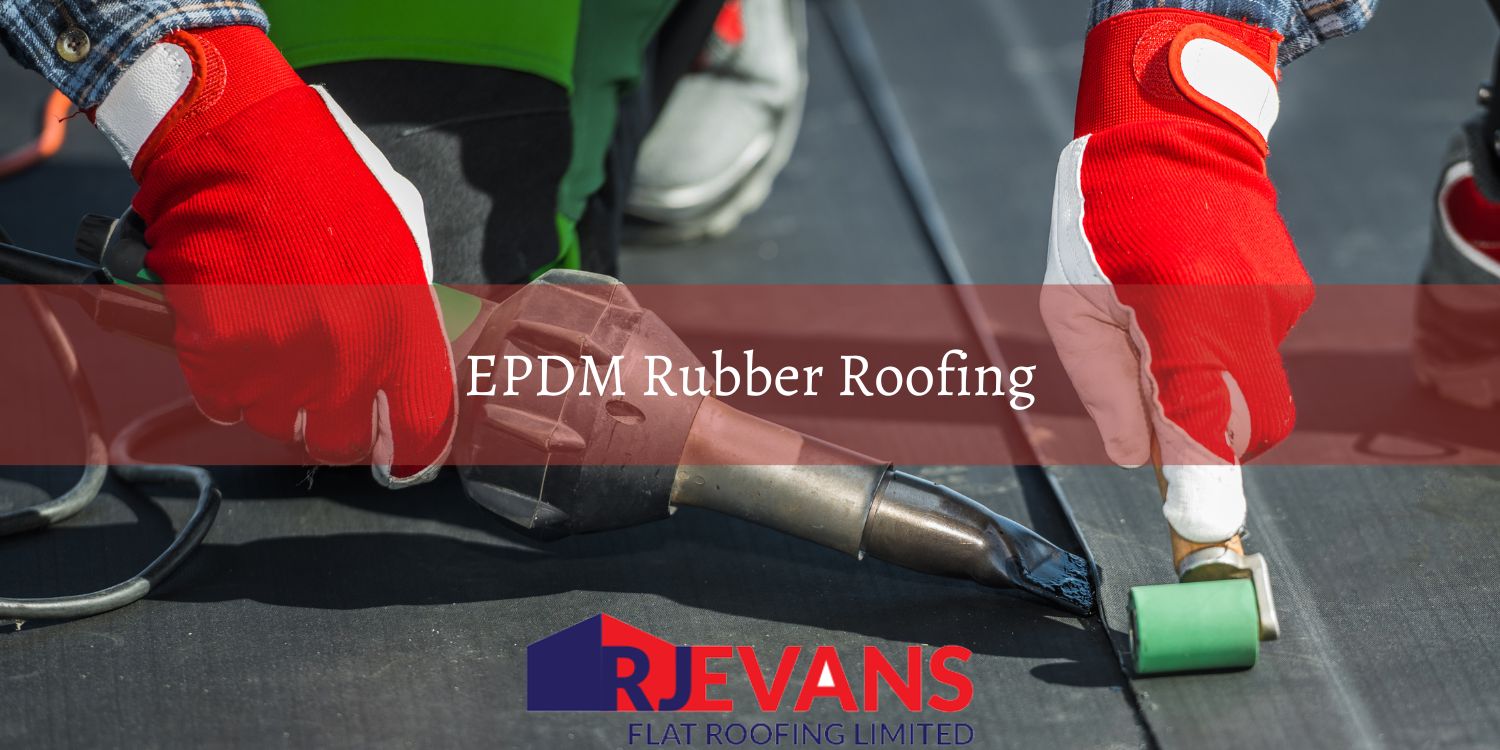
RJ Evans Flat Roofing Limited provides EPDM rubber roofing to prevent water ingress, protect flat and low-slope roof structures, and deliver durable waterproofing for commercial and residential buildings. EPDM rubber roofing is a roofing system that uses ethylene propylene diene monomer, a synthetic rubber membrane, as its primary waterproofing layer. The EPDM membrane forms a flexible, watertight barrier that protects the roof deck, insulation, and internal building areas while resisting weathering, ultraviolet radiation, and temperature extremes.
EPDM roofing membranes are supplied in large rolls or sheets, reducing the number of seams required across the roof surface. Depending on the roof design, substrate, and structural requirements, the membrane may be fully adhered, mechanically fastened, or secured with ballast. Seams, outlets, penetrations, upstands, edges, and adjoining details are sealed to maintain the continuity of the waterproofing system. EPDM rubber roofing is suitable for flat and low-slope roofs because it remains flexible, accommodates normal building movement, and requires relatively little routine maintenance. Correct installation and continued maintenance help preserve the membrane, prevent localised defects, and extend the usable service life of the roof. RJ Evans Flat Roofing Limited installs EPDM rubber roofing systems to keep roofs watertight, durable, and protected throughout their service life.
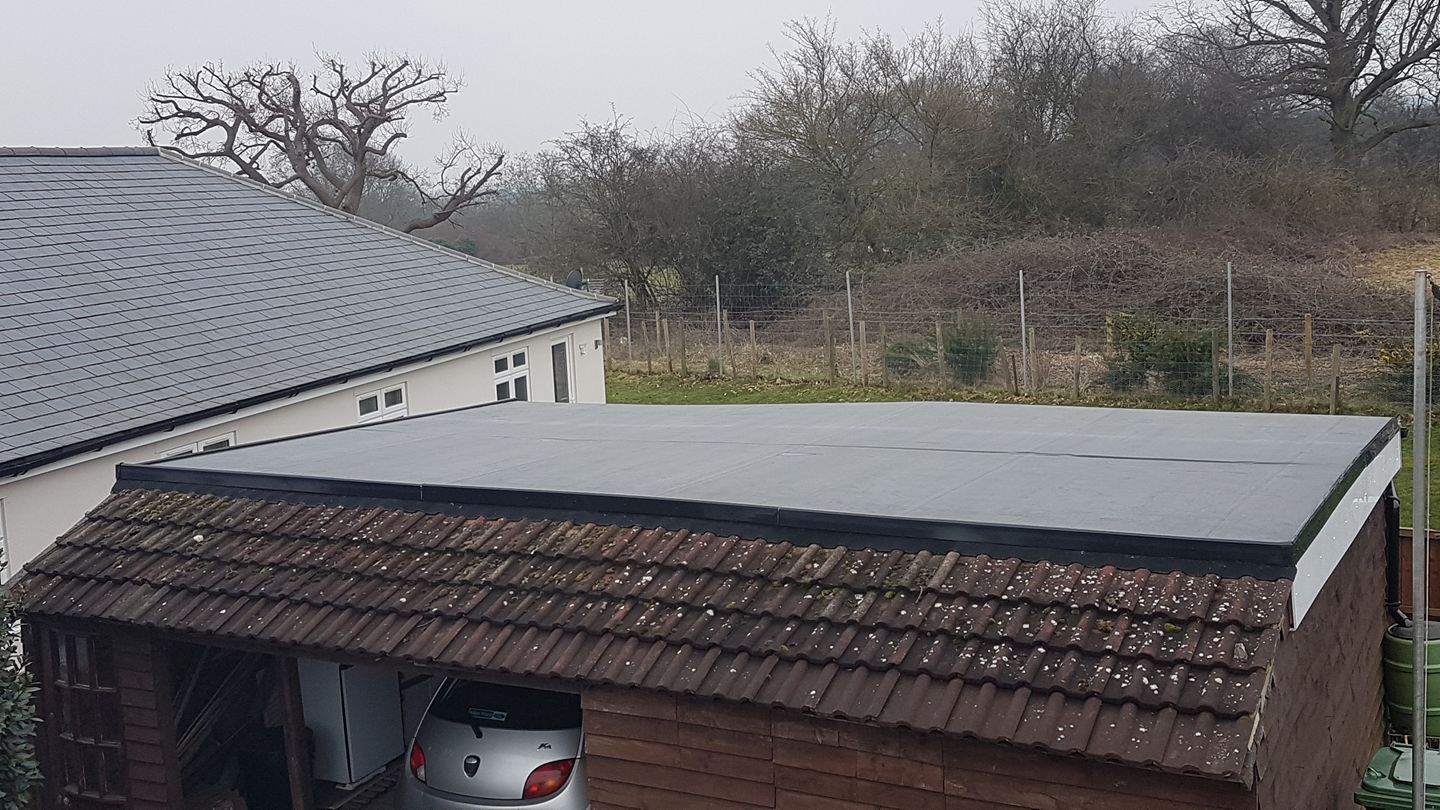
EPDM is a very strong, hard to penetrate in normal use, synthetic rubber roofing membrane. It is called ethylene propylene diene terpolymer. EPDM rubber roof membranes are extensively used in low fall designed industrial buildings. It was developed in the USA and was typically installed in a mechanically fixed way using wide rolls of product. This meant it was extremely fast to install. Originally used on roofs with low design criteria. This means large flat roofs with minimal pipework or plant on the surface.
Its two main ingredients, ethylene, and propylene are derived from oil and natural gas. It has a longer than normal life expectancy as it is not as affected as much by UV as some other flat roofing products like PVC and felt. Well over 1 billion square metres of EPDM have been installed worldwide since it became established as a membrane for commercial flat roofs. This is in no small amount due to its used as a flat roof material on large industrial and warehouse buildings across the United States.
To this day manufacturers continue supplying EPDM rubber roofs across America, where, it remains a popular waterproofing and ponding solution. Another reason for its popularity of this roofing material is the ability of the EPDM membrane to be weather resistant in extreme conditions both hot and cold. It can be installed as either a ballasted, fully adhered or mechanically fixed system. This makes it ideal for any roofing substrate. Worldwide EPDM rubber membranes market share stands at $5.1billion and between 10% and 14% of all construction projects. Not just roofing, but all types of waterproofing; including damp proofing and tanking. Worldwide it is fair to say it is the most widely used single ply roofing membrane.
• A quick and easy installation method: EPDM membranes are available in large sizes from 1.5M wide up to 15M wide. This means if the roofing project is clear massive areas can be installed in a very short time frame as the need to create a watertight seal for seam laps is drastically reduced.
• Very Durable: EPDM is very strong and does not contain plasticizers or flame retardants. It stays very stable over prolonged periods and is a very sustainable waterproofing solution as a consequence.
• Extremely flexible: EPDM remains flexible up to -45 degrees and its elongation is over 300%. This makes it ideal when coping with building movements.
• Low Maintenance: EPDM requires little effort to maintain. Normally, only a jet wash and the removal of organic matter is needed. It is also fully recyclable, which in modern construction is very important.
• Eco Friendly: EPDM membranes are an inert material and contains very limited toxic products. It is perfect for providing the waterproofing underneath green roofs.
Main summary of benefits for an EPDM roofing system; low installation cost, fewer seams meaning less potential water entry points, fast installation, long lasting and easy to maintain.
• Experienced team of fully accredited EPDM Rubber Flat Roof Specialists. We have operatives with more than 40 years’ experience.
• We provide a range of FREE quotations and solutions for all projects.
• Insurance backed guarantees.
• Excellent Customer Support throughout project.
• Rated 5 out of 5 from our previous customers.
If you would like a quotation or any further information regarding the installation or repair of an EPDM rubber roof please get in touch with us using our enquiry form or calling us on 01277 375 511. One of our friendly team of experts will be delighted to help you with your flat roofing project.
An EPDM roof is very long lasting. It requires minimal maintenance. An EPDM roof can last over 50 years. EPDM modern formulas are virtually impervious to radiation and damage from sunlight. They are very strong and easy to repair by just using a seam patch section.
As with many flat roofing systems the most common problems are often down to poor installation. Other common EPDM roofing problems are punctures or damage to, the rubber roofing material. However, this can be easily fixed.
It is an easy system to adhere down and with some care it is possible to put down on a roof surface. But in reality, only trained roofers should be installing any roof product.
EPDM roofing costs are much the same as PVC roofs. So, expect to pay at least £50m2 for a cold roof and up to £120 for a warm roof installation.
Yes. EPDM is suitable for any substrate, although it is suited to some much more than others.
Yes. liquid systems can be applied as an EPDM roof coating. The main importance here is to use the correct primer.