
I agree Our site saves small pieces of text information (cookies) on your device in order to deliver better content and for statistical purposes. You can disable the usage of cookies by changing the settings of your browser. By browsing our website without changing the browser settings you grant us permission to store that information on your device.
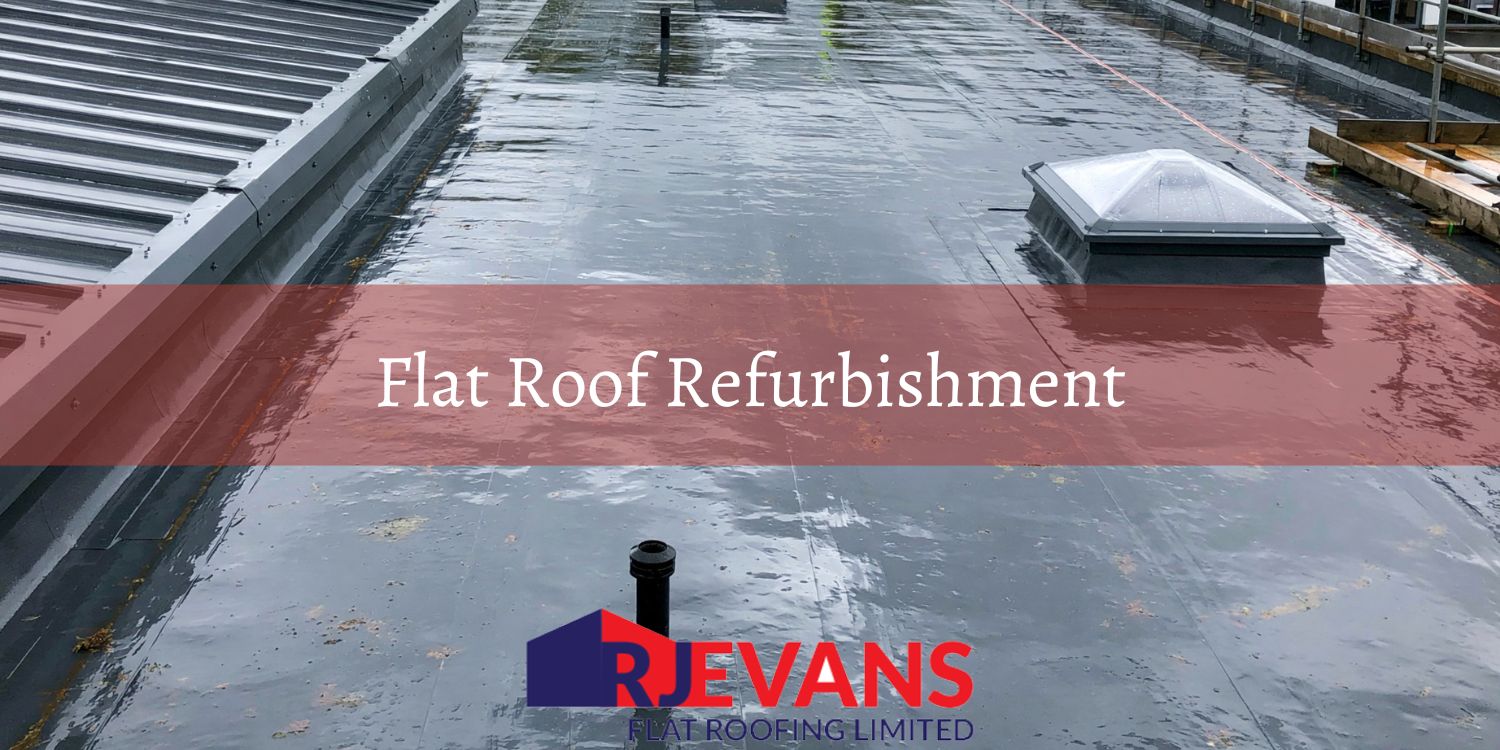
RJ Evans Flat Roofing Limited provides flat roof refurbishment for commercial and residential buildings to restore waterproofing performance, correct existing defects, and extend the service life of ageing flat roofing systems. Flat roof refurbishment is the process of improving an existing flat roof without necessarily removing and replacing the complete roofing system. The work begins with an assessment of the waterproof membrane, insulation, roof deck, drainage, flashings, penetrations, outlets, upstands, edges, and adjoining details to determine the condition of the roof and the refurbishment required.
Flat roof refurbishment may include repairing damaged membranes, replacing saturated insulation, improving drainage, renewing defective flashings, treating localised deterioration, and installing a compatible overlay or liquid-applied waterproofing system. The selected solution depends on the existing roof construction, substrate condition, extent of moisture damage, and remaining serviceability of the roof build-up. The completed refurbishment restores the continuity of the waterproof barrier, prevents water from reaching the insulation and roof deck, and protects internal building areas from moisture damage. RJ Evans Flat Roofing Limited carries out flat roof refurbishment to preserve suitable existing roof components, reduce the disruption associated with complete replacement, and keep commercial and residential flat roofs watertight, durable, and protected throughout their extended service life.
Flat roof refurbishment is the right solution when the existing roofing system retains enough structural and material integrity to be repaired, upgraded, and returned to reliable service without removing the complete roof build-up. The existing membrane may be ageing, locally damaged, or allowing water ingress, but the roof must remain capable of supporting a defined refurbishment strategy.
Before refurbishment is specified, the existing roof should be assessed through a visual condition survey, investigation of the roof build-up, moisture testing where required, inspection of the roof deck and fixings, drainage assessment, and compatibility checks for the proposed materials. This evidence determines whether the correct intervention is local repair, partial strip-and-replacement, a compatible overlay or liquid-applied system, or complete roof replacement.
Flat roof refurbishment may be appropriate where:
Ageing but viable waterproofing → the existing roof may be retained and refurbished.
The membrane may show surface wear, weathering, loss of protective finish, minor cracking, isolated blistering, or early seam deterioration while remaining adequately attached to a stable substrate. Where defective areas can be repaired and the retained membrane can support the proposed system, refurbishment can restore waterproofing continuity and extend the service life of the roof.
Confined moisture damage → affected roof components can be removed and reinstated locally.
Leaks associated with individual seams, flashings, outlets, penetrations, membrane defects, or damaged details do not necessarily require complete roof replacement. Where investigation confirms that moisture has not spread through the wider roof build-up, wet insulation, damaged boards, or defective membrane areas can be removed before the refurbishment system is installed.
Stable roof support → the retained assembly can support refurbishment.
The roof deck, fixings, and supporting components must remain suitable for the retained roof and any additional refurbishment materials. Localised deck defects may be repairable, but significant corrosion, decay, movement, deflection, or widespread loss of support must be investigated and corrected before waterproofing work proceeds.
Repairable drainage and detailing defects → continuous waterproofing can be restored.
Blocked outlets, leaking gutters, isolated low points, defective flashings, damaged upstands, failed edge details, and vulnerable penetrations may be corrected as part of the refurbishment. The completed roof must direct water towards suitable drainage points and maintain waterproofing continuity around every outlet, termination, penetration, and adjoining detail.
Compatible roof materials → the new system can bond and perform consistently.
The existing membrane, substrate, insulation, previous coatings, repair materials, primers, and proposed waterproofing system must be compatible. Surface condition, adhesion, trapped moisture, movement, fire performance, condensation risk, and the additional weight of the new build-up should be considered before an overlay or liquid-applied system is selected.
Suitable refurbishment design → the roof can continue to support the building’s use.
The proposed refurbishment must account for insulation, vapour control, internal temperature and humidity, drainage capacity, maintenance access, rooflights, ventilation, rooftop plant, and the expected use of the building. Refurbishment is appropriate where these requirements can be incorporated without relying on defective roof components or creating incompatible junctions.
A flat roof may remain suitable for refurbishment even when localised defects are present. However, any condition that could allow continued water ingress, prevent adhesion, restrict drainage, or weaken the retained roof build-up must be corrected before the full refurbishment system is installed.
Repairs may be required where:
Cracks, splits, punctures, blisters, or open seams → damaged membrane areas must be repaired.
Localised membrane defects can interrupt the waterproof barrier and allow moisture to enter the roof build-up. Damaged areas must be repaired, reinforced, or selectively replaced so the refurbishment system is installed over a stable and continuous surface.
Confined wet insulation or boards → affected materials must be removed and replaced.
Wet insulation can lose thermal performance, while moisture within cover boards or deck components can continue to cause deterioration beneath the visible surface. Where damage is confined to identifiable areas, the affected materials should be removed, the underlying condition assessed, and dry replacement components installed.
Failed waterproofing terminations → vulnerable perimeter details must be reconstructed.
Water commonly enters where the membrane meets walls, parapets, kerbs, roof edges, door thresholds, and adjoining construction. Loose flashings, inadequate upstand heights, open joints, damaged terminations, and defective edge details must be corrected so the new waterproofing system can terminate securely.
Restricted or misdirected water flow → drainage performance must be restored.
Blocked outlets, leaking gutters, deteriorated valleys, inadequate falls, and localised low points can cause standing water and increase stress on the waterproof membrane. These defects may require cleaning, repair, outlet replacement, localised levelling, or drainage modification before refurbishment is completed.
Failed interfaces within the roof surface → waterproofing details must be renewed.
Rooflights, vents, pipes, ducts, plant supports, access hatches, and movement joints interrupt the main waterproofing layer. Failed flashings, open seals, rigid repairs, and movement-related defects around these components must be corrected and integrated into the refurbishment system.
Unsuitable retained materials → defective layers must be removed, repaired, or isolated.
Old patches, sealants, paints, bituminous products, liquid coatings, and unidentified repair compounds may prevent the new system from bonding or moving consistently. Loose materials must be removed, retained surfaces must be tested, and incompatible areas must be treated in accordance with the selected refurbishment specification.
All required repairs must be completed before an overlay, coating, or liquid-applied waterproofing system is installed. Flat roof refurbishment should protect a stable, dry, correctly drained, and properly prepared roofing assembly rather than cover defects that could continue to cause moisture ingress or premature failure.
A flat roof overlay is only one possible refurbishment method. It is not appropriate where the retained roof cannot provide a dry, stable, compatible, and adequately supported base for the proposed system. An unsuitable roof may still be capable of refurbishment through partial stripping and replacement, but it should not be covered without correcting the underlying condition.
A flat roof overlay is not appropriate where:
Widespread trapped moisture → the existing roof should not be covered.
Moisture may extend through insulation, cover boards, vapour-control layers, fixings, deck components, and adjoining roof areas. Installing an overlay above saturated materials can trap water, reduce thermal performance, and conceal continued deterioration. Wet components must be removed before a new system is installed.
Loose or failing roof materials → the overlay would be attached to an unreliable base.
Widespread blistering, detachment, brittleness, splitting, soft areas, loose boards, or unstable surface layers can prevent the new system from performing consistently. Defective materials must be removed or replaced rather than retained beneath an overlay.
Unreliable adhesion or material compatibility → the proposed overlay cannot be specified safely.
Oils, persistent contamination, incompatible coatings, unidentified repair compounds, or chemically unsuitable membranes may prevent reliable adhesion. Where cleaning, preparation, priming, or isolation cannot produce a compatible surface, the affected materials must be removed.
Deck or structural instability → a surface-applied system cannot restore roof integrity.
Severe corrosion, decay, deflection, movement, damaged decking, or widespread loss of support prevents the retained assembly from carrying or securing the proposed overlay reliably. Structural repairs and replacement of affected roof components must be completed first.
Unresolvable drainage and level constraints → the roof construction must be redesigned.
Widespread low points, inadequate falls, restricted outlets, insufficient upstand heights, or limited threshold clearances may prevent the completed roof from draining and terminating correctly. Where these conditions cannot be corrected through local work, part or all of the existing roof build-up may need to be removed.
Unknown or inconsistent roof construction → further overlaying may preserve concealed failure.
Several generations of membranes, insulation, coatings, patches, and previous overlays can make it difficult to confirm moisture condition, attachment, compatibility, and structural capacity. Opening-up work or removal may be required before a dependable refurbishment strategy can be established.
Partial or complete replacement is required where defective components cannot be retained safely within the refurbished roof. The extent of replacement depends on whether deterioration is confined to defined sections or affects the roofing system as a complete assembly.
Partial replacement is appropriate where deterioration is too extensive for localised repair but remains confined to a clearly defined roof area. This may include one roof zone, drainage line, extension, rooflight section, perimeter area, or group of saturated insulation bays.
Partial replacement may be required where:
The defective section is removed and rebuilt before being connected to the retained roof through compatible waterproofing, insulation, drainage, and termination details. Partial replacement preserves serviceable roof areas while removing components that cannot remain within the refurbished system.
Complete replacement is required where deterioration, moisture, instability, or incompatible construction affects the roof as a complete system. Replacement should be selected where retaining the existing roof would trap damaged materials, conceal continued failure, or create an unreliable base for further refurbishment.
Complete flat roof replacement may be required where:
Complete replacement allows the existing roof build-up to be removed, concealed conditions to be exposed, and defective insulation, decks, fixings, and waterproofing materials to be replaced. The new roof can then be designed as one coordinated system incorporating suitable waterproofing, insulation, vapour control, drainage, roof details, and operational requirements.
RJ Evans Flat Roofing Limited determines the correct refurbishment pathway by assessing the flat roof as a complete assembly. Where the roof remains dry, stable, compatible, and repairable, an overlay or liquid-applied system may restore waterproofing performance. Where individual sections cannot be retained, partial replacement can be incorporated into the refurbishment. Where deterioration affects the complete roof system, full replacement is specified instead.